
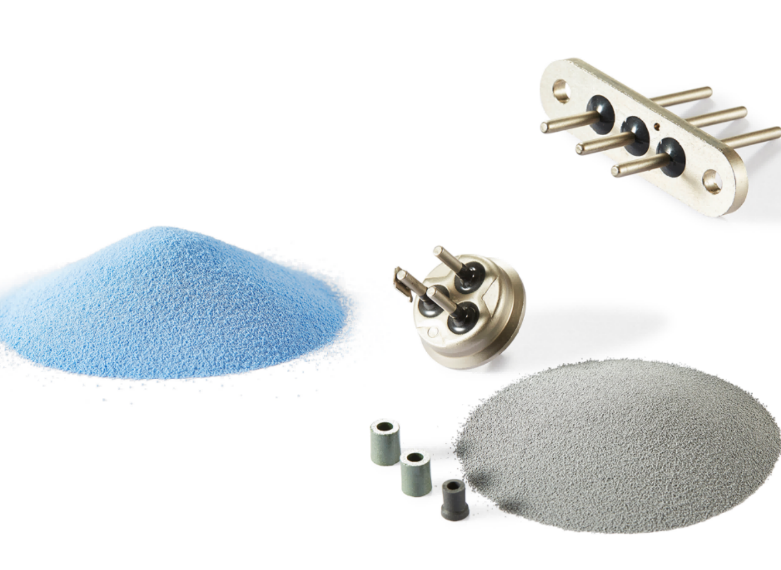
Glass powder, glass frit and sealing glass are related terms, but they do not always describe equivalent products · Glass powder usually emphasizes physical form, frit often describes a pre-fused glass composition that has been quenched and milled, and sealing glass emphasizes the intended joining or sealing function
Supplier terminology varies, so select by composition, thermal behavior, particle form, substrate compatibility and process requirements rather than by name alone
Terminology at a glance
| Term | Usually describes | Selection focus |
|---|---|---|
| Glass powder | A glass material supplied in particulate form | Composition, particle size, Tg, softening point, CTE and application |
| Glass frit | A pre-fused glass composition processed into granules or powder | Frit chemistry, milling, particle distribution and firing behavior |
| Sealing glass | A glass formulated or selected for joining and sealing components | Seal temperature, wetting, CTE match, substrates and required integrity |
Material form and functional role are different questions
A sealing glass may be supplied as powder, paste or another prepared form · A glass powder may instead be used as a sintering aid, dielectric ingredient, coating component or other functional additive · The public HTK Functional Glass Powder grades use the approved htk naming system, including htk66, and do not imply that every grade is a sealing-glass replacement
Key parameters for comparison
- Glass composition and restricted-substance requirements
- Glass transition temperature and softening point
- Coefficient of thermal expansion over the stated range
- Particle-size distribution and supplied form
- Firing or sealing profile and atmosphere
- Substrate, metal, ceramic or glass compatibility
- Electrical, optical or mechanical function required after firing
Process questions to settle before selection
- Will the material be printed, dispensed, coated, pressed or blended
- What drying, binder-burnout and firing steps are available
- What gap, bond-line or coating thickness is required
- Which substrates must be joined or protected
- What dimensional, electrical or sealing result defines acceptance
Do not assume interchangeability
Two powders with similar softening points may differ in CTE, wetting, crystallization, particle distribution or compatibility · A name match or one property match is not evidence of equivalence · Evaluate the candidate in the intended process and assembly